BlogHispanic Canadian Voices
A Conversation with Four Young Hispanic Canadians
It’s sunny, and anyone might think it’s a warm, pleasant day. But this is my second winter in Toronto, and I’ve already learned that sunshine does not guarantee warmth. In fact, for weeks now, temperatures have stubbornly remained below zero, and in January more than sixty centimeters of snow fell in the GTA in a single day, setting a new record.
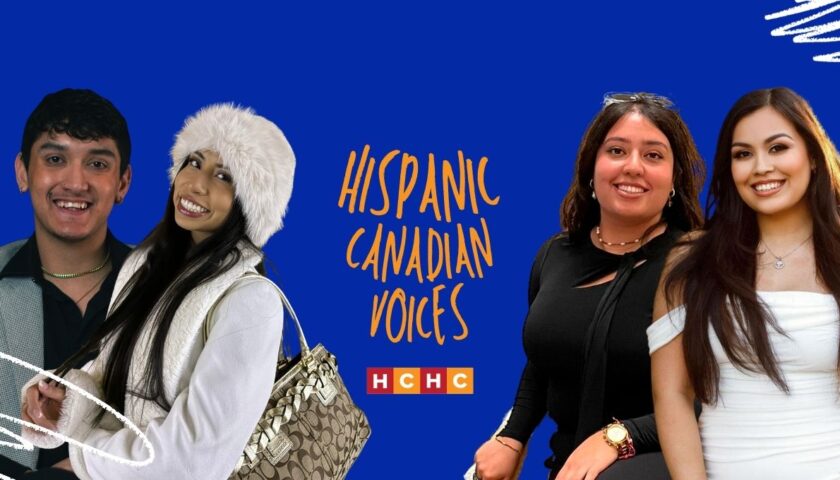
Given the weather conditions that limit in-person meetings, I decide to coordinate the four interviews for this first publication of Hispanic Canadian Voices, the new HCHC blog, via Zoom. On the other side of my screen, I meet with four bilingual and bicultural young adults who grew up between two worlds, and whose Hispanic Canadian identities allow them to see and understand reality from more than one perspective.
The Espanglish Generation
I ask them to introduce themselves in two sentences. Santiago Rivera, Colombian, describes himself as a multidisciplinary creative and speaks passionately about how much he enjoys his work as Operations Curator at Pride Toronto. Alanis Ortiz Espinoza, the daughter of Panamanian parents and a corporate lawyer, proudly tells me that she loves collaborating as a volunteer on boards and currently serves as Director of Communications for the Canadian Hispanic Bar Association. Celesty Gomez, a post-graduate student and the daughter of Nicaraguan parents, tells me that both Canadian and Nicaraguan cultures deeply influence how she sees herself and the world around her, in both her personal and academic life. And Claudia Sánchez-Jara, born to Chilean parents, shares her enthusiasm for creative activities. For her, art is a powerful way to translate her thoughts, emotions, and ideas through her two languages: English and Spanish.
Santiago, Alanis, Claudia, and Celesty are far more used to the cold than I am. All four grew up in Canada and they are more seasoned than me when it comes to the weather. Still, none of them chooses winter as their favorite season. When I ask, they prefer fall and summer, an answer that subtly reveals their Hispanic side.
They also have in common their participation in the documentary “The Espanglish Generation”—directed by Oscar Vigil and co-produced by Sergio Lasky and Jonathan Smith—which premiered at LATAFF in 2024. Through interviews, the documentary explores the stories of many Hispanic Canadians born after 1990, who reflect honestly and deeply on their bicultural and bilingual identities.
Their Experience in the Documentary
They all agree that sharing their stories for the documentary was an enriching and, in some cases, transformative experience.
Alanis and Claudia agree that the film gave them the opportunity to reflect collectively on their own identities, a conversation that doesn’t happen very often or in just any space, and to discover common ground in the stories of other young people with similar paths. “It meant creating something for the community, by the community”, says Claudia.
For Santiago, it was a pivotal moment. When the interviews were filmed in the summer of 2023, he was about to begin his final year of university, and the documentary motivated him to enroll in Spanish classes. “It reminded me of who I was and where I came from,” he explains. Celesty is proud to have participated. For her the film has had a long lasting impact because it is a constant reminder of the importance of using her own voice, especially as a Latina in a university environment that lacks significant cultural diversity.
Growing Up in Canada with Latin American Parents
Like many young people with immigrant parents, Alanis, Santiago, Celesty, and Claudia grew up between two worlds, aware from an early age of the differences between home and school.
At home, they spoke Spanish, ate traditional dishes from their parents’ home countries, and celebrated national holidays. In Claudia’s house, empanadas were always on the table on September 18th, Chile’s Independence Day, and pastel de choclo was a special dish for her birthday.
At school, on the other hand, they learned English and, from a very young age, began to understand how to inhabit both worlds. Celesty recalls that when she was in first grade, she was asked to help a new classmate from El Salvador communicate, since they both spoke Spanish. For her, that moment was one of the first times she realized that her cultural background was different from that of many of her peers.
Being different, however, was not a negative experience throughout their childhoods. Alanis never felt excluded because everyone around her was also different. She had friends from other countries, and they would always share stories about their cultures. For Santiago, the lack of Hispanic role models during his educational journey, rather than discouraging him, pushed him to excel academically and later to become a student representative at university.
Two Identities That Enrich Each Other
Now, as young adults in their twenties, they are clear about what biculturalism means to them. Being Canadian gives them opportunities, stability, and diversity; being Hispanic gives them a sense of belonging, warmth, and a particular way of understanding family and community. None of them frames having more than one cultural identity as something to choose from, but rather as two identities that complement and enrich each other.
They describe Canada as a place defined by diversity and coexistence. “It’s a country where people of all religions can be friends. And that’s something really beautiful,” says Alanis. The ability to share spaces with people from different backgrounds, languages, and beliefs emerges as one of the greatest lessons of growing up in this country.
Along with diversity, they all repeat the word “opportunities”. Many families who migrate to Canada do so in search of educational and professional opportunities that are not always available in their countries of origin. All four acknowledge those family sacrifices as part of their story. “One of the main reasons my mom left Colombia and Costa Rica was so that we could have that possibility, that ability to have what we wish for and work to achieve it,” Santiago explains.
When they talk about what it means to be Hispanic, relationships, family, and community come to the forefront. “The best thing about being Latina is the deeply rooted family values that shape how we love, support, and show up for one another,” says Celesty. For Santiago, what unites them is also an attitude toward life: “our drive, our passion, our unity, and our strength”.
What’s Ahead
To close the conversation, I ask them for one word that defines their lives in Canada today. “Exciting, evolving, ambitious, wholesome”. Their answers denote a sense of grounding in their Hispanic Canadian roots, but also a vision of the future they want to build for themselves.
Long after the Zoom calls, I cannot stop thinking about something Alanis said: “There are many people like me, so I’m not the only one, but it’s an interesting place to be, like in between.” Her phrase captures the sentiment that runs through this entire story, the experience of inhabiting more than one world at once and recognizing the best in each of them.
Maria Pia Maiti
Hispanic Canadian Voices
This conversation is part of Hispanic Canadian Voices, a space for reflections and conversations within the Hispanic community in Canada.